Multi-Region High Availability & Disaster Recovery (HADR) for Django
Designed and architected a robust, multi-region AWS infrastructure to host a mission-critical Django application. The solution implements a Warm Standby disaster recovery strategy, ensuring a Recovery Point Objective (RPO) of seconds and a Recovery Time Objective (RTO) of minutes, while optimizing for cost-efficiency.
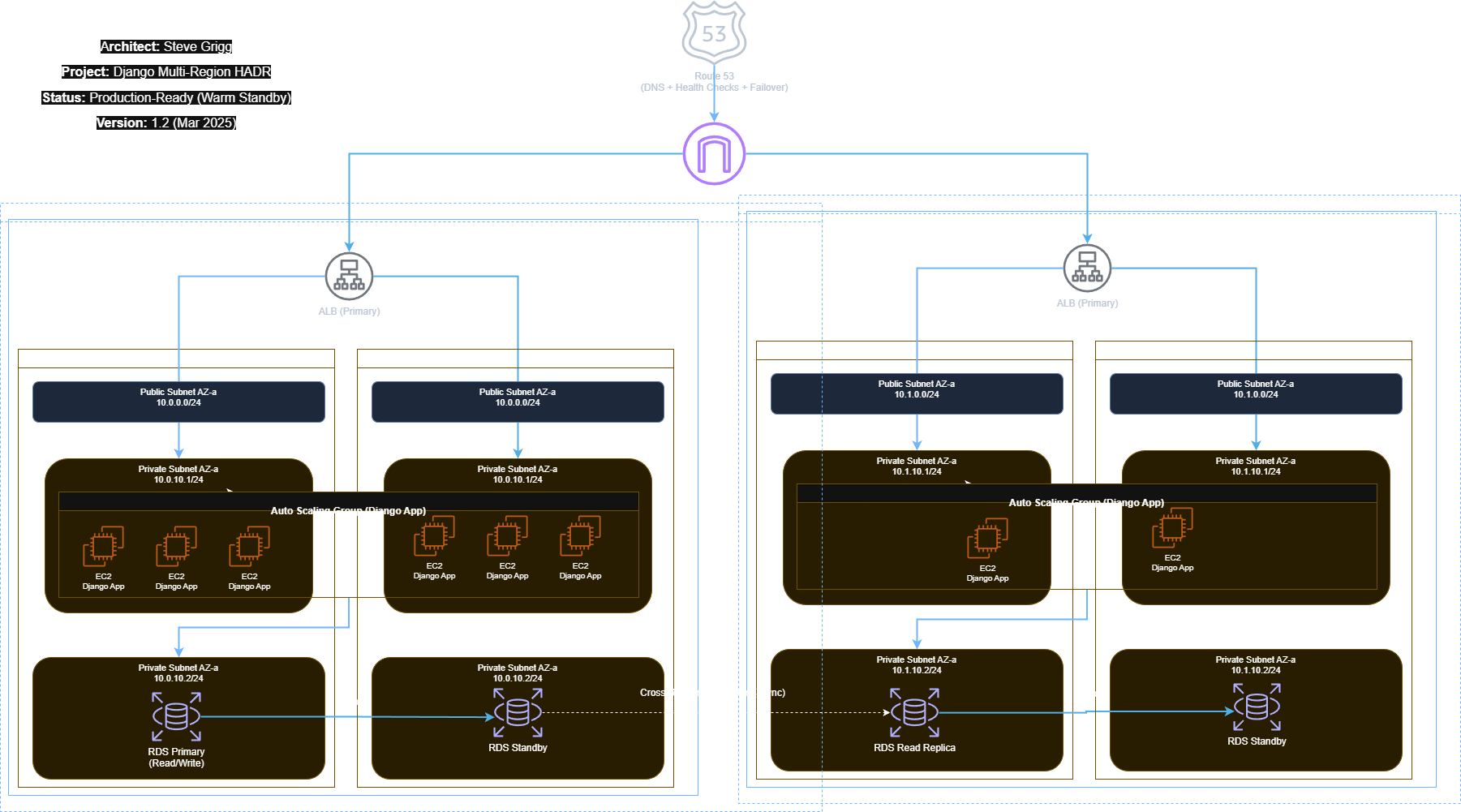
Technical Architecture Breakdown
1. Global Traffic Management & DNS
- Service: Amazon Route 53
- Implementation: Configured Failover Routing policies with integrated Health Checks.
- Logic: Traffic is directed to the Primary Region (us-west-2) by default. If the primary health check fails, Route 53 automatically updates DNS records to point to the Secondary Region (us-east-1).
2. Scalable Compute Layer (Django App)
- Services: EC2, Application Load Balancer (ALB), Auto Scaling Group (ASG)
- Availability: Deployed across three Availability Zones (Multi-AZ) in each region to ensure fault tolerance.
- Warm Standby Logic:
- Region 1 (Primary): Runs at full production capacity to handle active user load.
- Region 2 (Secondary): Maintained at "minimum scale" (1 small instance) to keep the environment warm. This reduces idle costs by ~80% compared to a Hot Standby, while allowing the ASG to scale up to production levels immediately upon failover.
3. Data Persistence & Replication
- Service: Amazon RDS (PostgreSQL/MySQL)
- Strategy:
- Primary Region: Multi-AZ deployment for synchronous local failover.
- Cross-Region: Established an Asynchronous Read Replica in Region 2.
- Failover Protocol: In a disaster scenario, the Read Replica is manually promoted to a standalone Primary instance to accept write traffic, ensuring minimal data loss.
4. Networking & Security
- VPC Design: Isolated VPCs in both regions with non-overlapping CIDR blocks to allow for future VPC Peering or Shared Services expansion.
- Security: Implemented IAM roles with the Principle of Least Privilege, and Security Groups restricted to necessary ports (80/443 for ALB, 5432 for DB).
Future Roadmap (Next Phase)
Automation (IaC)
Migrating this manual architecture to Terraform or AWS CloudFormation for one-click deployment.
CI/CD
Integrating with AWS CodePipeline for automated Django deployments.
Serverless
Evaluating AWS Lambda for background task processing to further reduce EC2 overhead.